Crawl, Walk, Run: A Practical Framework for Bringing AI Into Your Investment Process
The 9:45 a.m. problem
It's 9:45 a.m. and a portfolio manager's book is down two percent. The risk team covers a thousand positions across a handful of people, so they can't know every name the way the PM does, and the phone starts ringing. That was the scenario Omega Point's Omer Cedar and Joel Coverdale discussed at TSAM NY’s conference this month, and it will sound familiar to anyone who has sat on a risk desk during a rough morning.
Before today, that morning would go like this: pull P&L name by name, check sectors and factor exposures separately, manually cross-reference against the news, and discover, as is usually the case, that it isn't one name driving the move but several things at once. Every other project on the desk gets dropped to fight the fire. It can take quite a while to do all this. And that’s just for one portfolio…
The panel's pitch for the future version of that morning wasn't about pushing a button and getting an answer. It was about asking what's moving and why, in plain language, with all the relevant information (thematic exposure, factor exposure, idiosyncratic moves) parsed for significance and surfaced together, and room to have a dialogue and dig in rather than a single pass and done. Minutes, not a scrambled afternoon.
Every investment team wants that future. The honest part of the discussion, worth repeating here, is the caveat that came with it: you don't get there by flipping a switch. You get there by knowing your system, then knowing your own workflows, and building the two together deliberately, one piece at a time.
Four questions before you trust any AI solution
Before an investment team lets an AI tool anywhere near a real decision, there's a frame of reference worth applying to the tool itself, not just to what it produces. Four questions, in order:
- Does it have domain expertise? Was it built by people who've done the job (analysts, PMs, risk managers), or just trained on data about it? How many years of experience does the builder have? Five? Ten? Or are they true veterans with 25+ years of domain experience, who know how to train the solution because they’ve lived through the scenarios that matter. The harness around the model matters as much as, if not more than, the model.
- Is it computed, or inferred? A trustworthy number comes from a real calculation, not a model's best guess at what one would look like. For numbers that you’re making decisions on, and acting on, it’s important to ensure the output was processed through the right workflows & methodologies, and calculated by a proven backend system before an LLM even touches the final output and translates it into an answer.
- Can you trace it to the source? If it was processed and calculated, and not just inferred by an LLM, then every figure should link back to the data and model that produced it, not just sound plausible. This is really important when determining if you can act on an insight or if the LLM has simply made the insight sound confident, but is actually wrong.
- Is access governed by design? If you can't see a position or an exposure, the agent shouldn't be able to either. Scope should follow entitlements, not bypass them. Entitlements are important not only for licensing, but to ensure the correct data is being used to make decisions. If the wrong data that you’re not entitled to is accessible, then the wrong answers are likely to occur as well. In order to have confidence in taking action on the insights you produce using AI, it’s important to know the right data sources were used.
None of these are exotic asks. They're the same due diligence questions an investment team already runs on a data vendor or a risk model. The only change is that they now apply to the layer sitting on top of those systems too, and they're worth putting to any AI tool a team evaluates, including whatever it's already using today.
Is it helping or hindering? A practitioner's checklist
Not every AI use case in an investment process is a good one, and the panel offered a five-question checklist for telling the difference. Run any proposed use through these signals before committing to it:
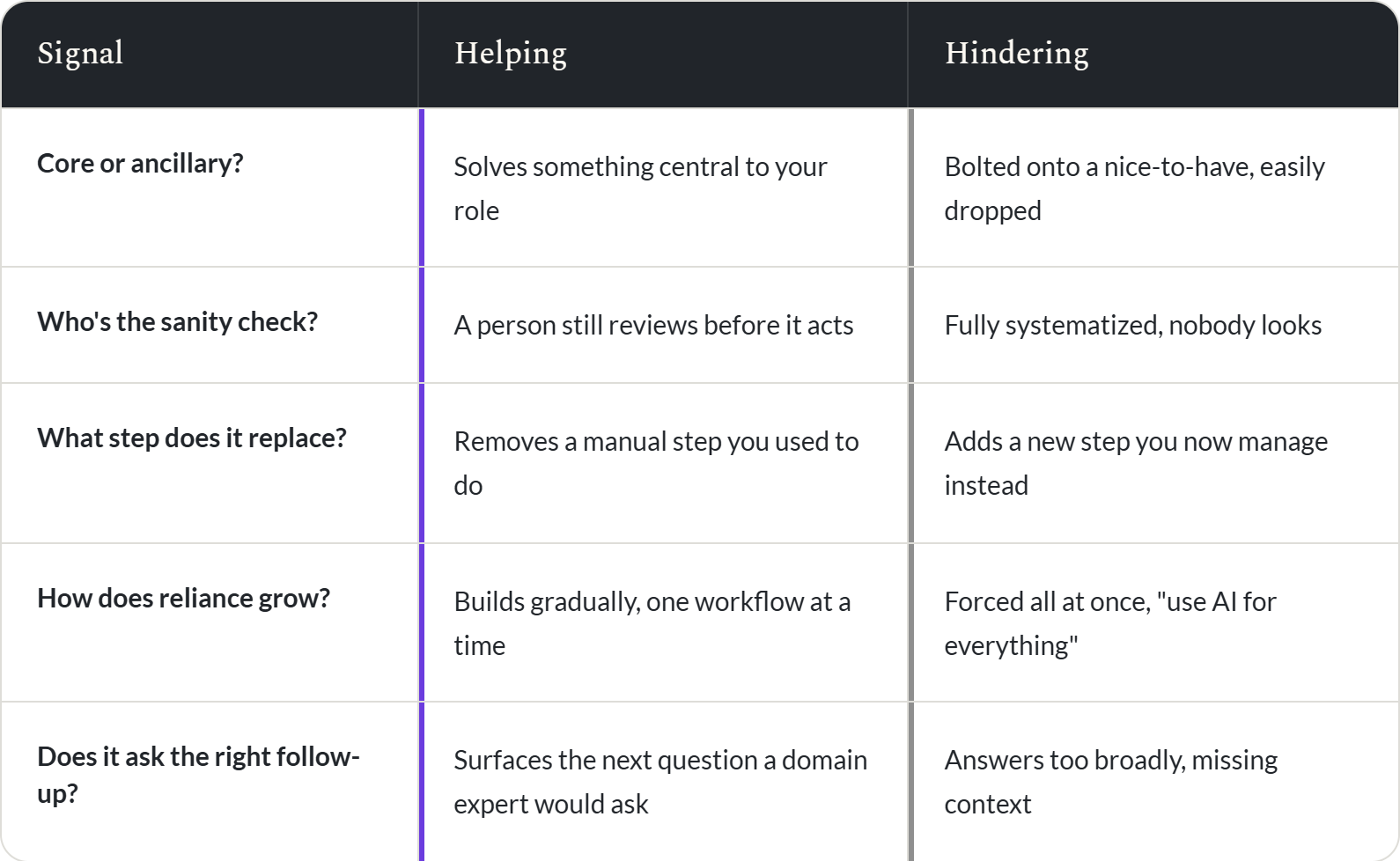
The pattern across all five rows is the same. AI is helping when it removes friction from something a person is still steering, and hindering when it becomes a black box a team defers to instead of a tool a team directs.
Crawl, walk, run
Omer and Joel reframe the whole adoption question. It isn't whether to use AI, it's where it actually saves time and where it doesn't. That gets answered incrementally, not all at once.
- Crawl. Start with a single question you know the answer to (What’s my Bank’s exposure? Am I underweight Tech?). Test it out and make sure the answer you get is the answer you expect. Then ask another question, gut check it. Now ask something new, and validate the source and methodology to confirm. Once you’re comfortable with this step, move onto your first automation.
- Walk. Automate one recurring piece of the process, like a morning report or a routine scan. Again, start with an automation you already run and confirm its accuracy (your daily risk report here is a great starter - complete with a dashboard). Now build on that report or create a new dashboard by adding another insight or chart. Start to customize your reports into your world view, how you like to look at data. Try running another report or drill down into an existing report. Again, validate the data by looking at the source, and gut check that it’s right. Next try running an analysis on something you’ve always wanted to run, but haven’t had the time to look into until now. Schedule a notification of a report or two, so you have it when you need it.
- Run. Now build on the single reports and automations and weave agentic workflows into the core process itself, each one building on the last (Daily risk report > identify largest risk exposures > map to short term thematic market moves > identify areas of concern in the portfolio > suggest hedges or areas of further research > align with current alpha views > highlight mismatches > rerun an adjusted daily risk report…). Identify automations that you just validated and combine them into a workflow you can scale. Start by combining two automations and try that out for a few days. Now combine 3 or 4 automations. Is there a process you normally run only every few weeks, because it’s time consuming that you can now scale by running every day?
The order matters more than the speed. Start with a core function, not something ancillary, and let each step earn the next. Saving real time is an iterative process, not a single decision made once in a planning meeting.
How to get started
For a team ready to move past the crawl stage, a few things are worth doing before doing anything else.
Pick one workflow that's actually core to the role, not the nice-to-have that's easiest to greenlight. The morning fire drill, an earnings screen, a monthly risk review: something a person already owns start to finish, so there's a real before and after to measure.
Then measure it. Resist the urge to roll out five use cases in the same quarter. You'll have no idea which one actually moved anything.
Keep a human in the loop on purpose, not by accident. The checklist above only works if someone is actually running it, so decide up front who reviews outputs and how often, rather than letting that review quietly lapse once the tool starts looking reliable.
Ask the four architecture questions of what you're already using, not just the new vendor pitching you. Domain expertise, computed versus inferred, traceability, governed access: they apply just as much to a tool that's already live on your desk.
Expect the strongest case for AI to sound almost boring. It's rarely that a tool answers one question faster. It's that it can run the same check across a thousand names at once instead of one at a time. If a use case can't clear that bar, it's probably the ancillary kind.
Trust isn't assumed. It's built.
The discussion closed with three takeaways, and they hold up as a summary of the whole discussion:
- Start with one core workflow and measure what it saves before adding the next;
- keep a human as the sanity check, verifying rather than systematizing blindly; and
- remember that trust in an AI system isn't something a vendor asserts, it's something built through being computed, traced, and governed.
Investment teams are going to keep getting asked, from boards and from clients alike, what their AI plan is. The honest answer, at least for now, is that there isn't a single plan so much as a discipline: evaluate the system the way you'd evaluate any other piece of your process, start small on something that matters, and let the results tell you what to automate next. Omega Point has been working through exactly this process with clients navigating their own AI adoption, and it's a conversation worth having early, before the tooling decisions get made for you.