Software Isn't Dying. The Click Is.
Now Validating Is More Important Than Ever
I was rewatching WarGames recently, the 1983 Matthew Broderick classic. And it got me thinking. This whole narrative about software dying that is literally everywhere in 2026 is a misnomer. Software’s not dying per se. It’s changing. It’s evolving.
In the movie, Matthew plays David Lightman, who morphs from a nerdy high school hacker into a pivotal figure in global nuclear warfare. And all from his bedroom. In those days everything was text based. The MS-DOS command line blinking at you waiting for an input. The barrier to entry was huge. I’m sure, like me, your first thought when presented with that interface was, well what do I do? Well, what you needed to do was go and learn how to code using a 600 page textbook. Only then would you have a hope of interacting in a meaningful way.
Innovation followed swiftly as both software and hardware lowered that barrier to entry further and further. PCs got an operating system: Windows. Then the iPad took away the need for even a mouse as touch became the new norm. At each stage of evolution, more and more people were able to get value from these tools. But notice what else was happening quietly in the background. The platforms that won at each stage weren't just the easiest to use, they'd spent years accumulating something a newcomer couldn't fake: an installed base, a library of history, a depth of data nobody else had. Ease of use got you in the door. What you'd built up over time is what kept you there.
And that brings us to now and AI. This isn't a hypothetical future; enterprises are already running an average of 28 AI agents each[1], with plans to nearly double that within the year. Software that requires you to point-and-click, and hunt through menus, and be restricted by what the software developer wants you to see and do: that’s what’s dying. But the software is still there. It’s just the interface that’s changing. Now you can just ask for what you want, and get the results you need. You are no longer restricted by what someone else wants you to do...
Of course there is a danger here that is all too obvious to spot. If the barriers to entry are so low now and I just have to ask for what I want, without any prior effort on the user’s part to learn, how do I know the output is what I am looking for? How do I know that the AI is making the right choices and providing me with the right information? In the world of Investment Management, when the answers are mission critical, that’s a deal-breaker.
How to sort the wheat from the chaff? It comes down to three key areas: accuracy, trust and time.
Fundamentally, AI models are probabilistic by nature. The sequence of what you have written so far is run iteratively through a neural network to predict what the next word in the chain should be. Of course, that kind of inference is anathema to a production grade calculation that has a unique and deterministic answer. So how to bridge the gap? The answer here is two-fold. Firstly, the workflows that are built around the AI model to tell it how to achieve what it needs will be critical. That means domain expertise from people who've actually practiced the discipline, not just studied it. Imagine a world where you have access to the knowledge of a veteran practitioner, whenever you need it, however many times it’s required. What used to be a scarce resource becomes knowledge sharable with your whole organisation. Everyone gets better. But that expertise is only ever the raw material. What a firm does with it, which questions it chooses to ask, which parts of its own process it wraps around that judgment, stays entirely its own.The firm’s edge becomes sharper.
Secondly, not only do you need the accurate workflows, you need a calculation engine, with all the clean and processed data, to actually do the number crunching. Accuracy will therefore be delivered with a combination of expert-built workflows linked to an industry-grade calculation engine. The answer then isn't a guess, it's a validated, traceable methodology executing on your behalf. The question you need to ask is simple: Is the output a definitive, traceable result? Is it computed against industry-standard methodology using real, clean data, not generated by a model pattern-matching its way to something that merely sounds right? Look through the AI to the software platform beneath.
Even with that dichotomy resolved, there is still the issue of ensuring the AI can only do what you tell it to do, look at the things you tell it to, and not go rogue on you. That trust can only be granted with a bullet-proof governance model built into the agent, not bolted on after. Your agent should follow your access, not the other way around. An AI agent operating with no permissions model, no audit trail, and no data lineage underneath it inevitably needs those things retrofitted before anyone will actually rely on it. But at that point it's no longer just an agent, it's an agent wrapped in everything a real application already provides. The reason zero-click can be trusted here is that the governed structure was already the foundation, not an afterthought. Does the underlying software fulfill these criteria? Is it institutional grade and established or a new entrant? Ultimately, nothing is being handed over except the friction of getting to the answer. So don’t just blindly trust, verify.
Finally, there's the question of time. In today’s immediacy-focused culture, having to wait for anything seems like an inconvenience at best, and a deal-breaker at worst. But not every answer should take the same amount of time, and that's actually the point. A simple question should come back in an instant. A genuinely complex calculation crunching real numbers against real methodology should take exactly as long as that calculation actually takes, no more, no less. Be suspicious of a system that returns the same confident speed regardless of what you've asked it. That's not efficiency. That's a model guessing and that destroys trust. And rejoice because even if it takes 5 minutes to run your analysis, that’s 5 minutes you are not struggling with the software, trying to find the right menus to click, and 5 minutes in which you can set off another task, or just focus on something else.
Ultimately, AI is unlocking the ability for Investment firms to accentuate their IP and create more differentiation than ever before. Software's interface is shifting from something you navigate to something you ask. But the software’s job is still the same: deliver expert-built, validated process so it can be trusted. The decision, and the outcome, are still yours.
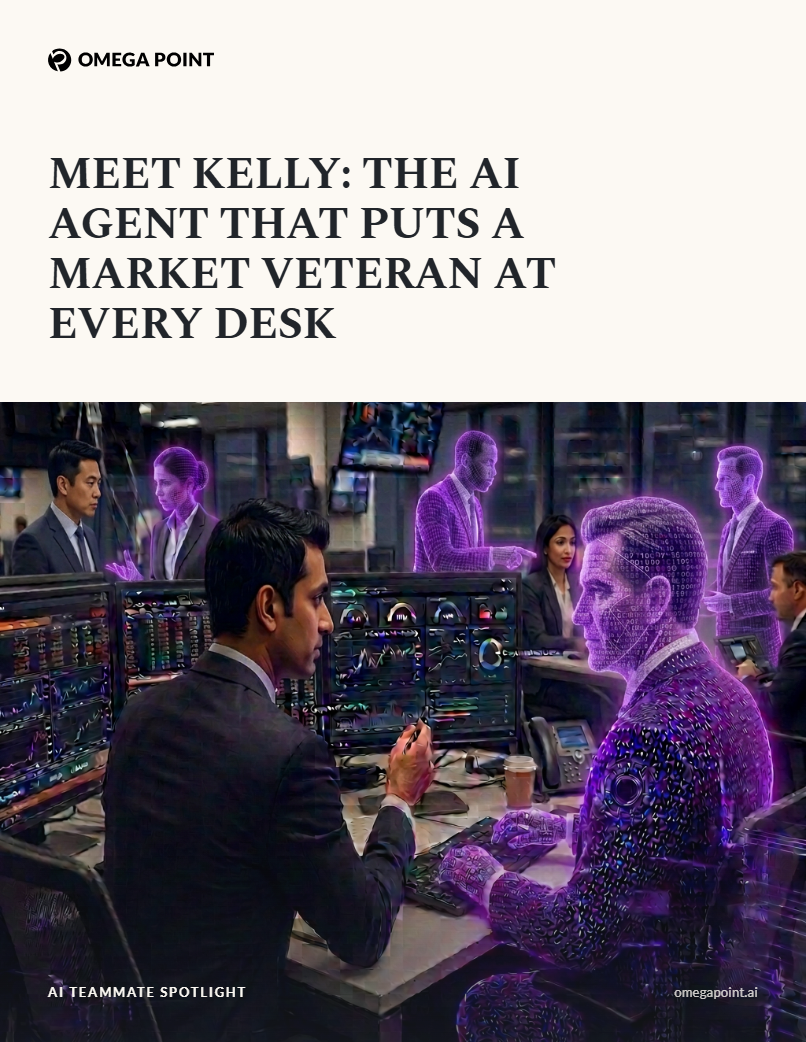
Trust but verify was Cold War doctrine for a reason. It's what happens when the stakes are too high for blind faith. The next generation of software for the Investment Management industry is being built on the same principle: ask freely, but expect every answer to show its work. That's not a hypothetical future. It's already arrived. Omega Point is once again leading the way by building accuracy and trust in every AI interaction with their MCP and Kelly. The future of software lives behind the scenes, where clicks and navigation cease to exist. But before you start adopting one of 28 different AI agents, a foundational requirement should be verifiable trust and accuracy.
Stay tuned as we delve into the future of software and AI for investment management and investment intelligence.
[1] Dynatrace's Pulse of Agentic AI 2026 report