Blind Spots: The Value of the Question You Didn't Think to Ask
Ask AI a generic question, you get a generic answer. This was a key point Philip Maymin made during his keynote speech at TSAM NY last Wednesday.
AI is very good with averages. You point it at your portfolio, ask what is going on, and you get more or less the same answer as everyone else who asked. Usually, that is not where the risk is.
That's not surprising. A generic question asked of a generic model returns the answer most people would already guess: the biggest sector bet, the most obvious factor tilt, the trade everyone already knows is crowded. None of that is wrong, it's just already on your radar.
In risk management we are very good at watching the things we already know to watch. Is the hedge still working? How crowded is this trade? These are questions we know to ask. The losses that really hurt usually come from the questions nobody thought to ask. These are blind spots.
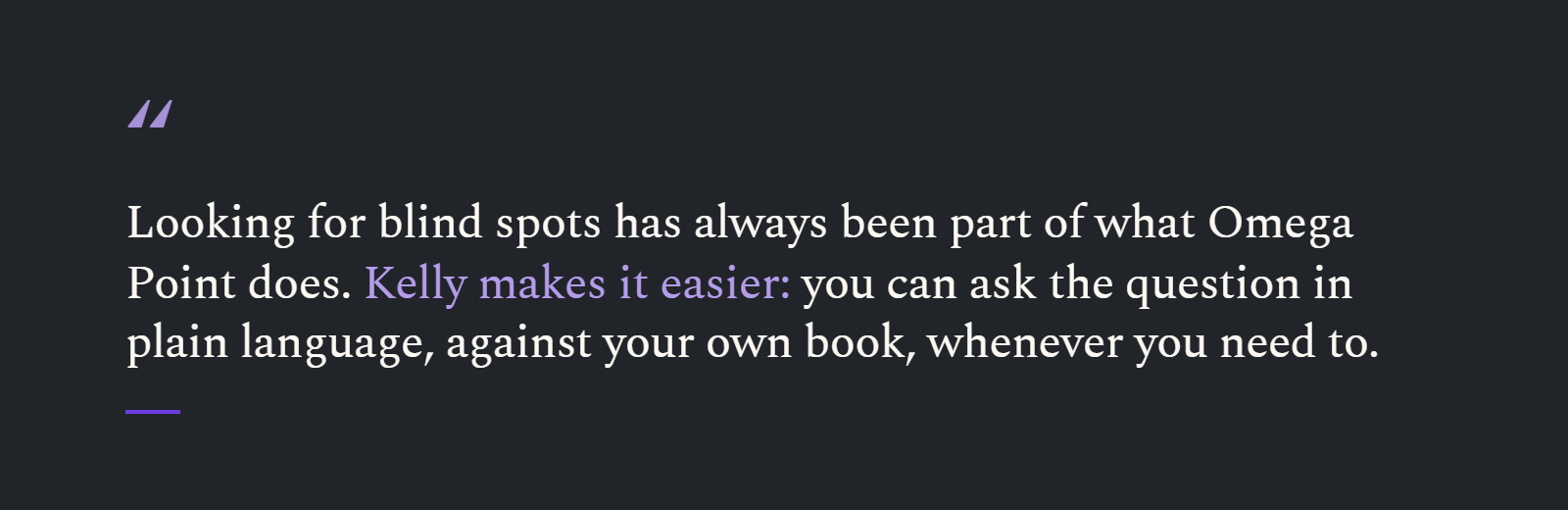
Blind spots aren't random, they're structural. Most risk models are built to measure a known set of factors: style, sector, macro. What falls outside that list doesn't disappear, it just moves into the part of the portfolio nobody is watching as closely, the idiosyncratic, stock-specific piece of risk. That's usually where the surprise comes from, not because the risk is small, but because nothing in the standard process points you toward it.
AI will not find them if you ask it to agree with you. It wants to be helpful, and very often this means telling you that your thinking is sound. So flip the question. Don't ask "is my book positioned well?" Ask "what am I not seeing?"
This only works as a habit, not a one-time exercise. A single good question against your book tells you something once. Asking it again next week, and the week after, against a portfolio that has actually changed, is what turns a blind spot into something you manage instead of something that eventually manages you.
Most PMs already ask the hard question, at least sometimes. The real issue is usually who they're asking. A generalized AI model reflects the judgment of whoever trained it. Ask a question to one trained by someone a few years into their career, and ask the same question to one trained by a 25-year veteran who has sat through multiple cycles, and you will get two different answers. Not because one is faster. Because one has actually seen more books break.
That's the real value of having a veteran beside you. It isn't speed. It's judgment built from decades of watching where positions actually went wrong, applied to your specific question, every time you ask it.
This is where Kelly comes in. Kelly is Omega Point’s AI agent, and it works directly with your portfolio and risk model inside the platform. So you can ask a question you might not normally pose, for example "what themes are driving my idio?" By design, most risk models don't have theme factors, so this exposure sits in the stock-specific part, where few people look. Kelly is answering about your book, not a hypothetical one, and the answer might tell you something you didn't expect.
Blind spots are not a new idea for us. Omega Point's risk analytics have spent the last 13 years built around exactly this kind of question, the exposures standard risk models don't surface and firms don't think to check. Kelly didn't invent finding the blind spots, it just makes it easier to proactively see them every day instead of once a quarter. The more you ask, the more Kelly learns which questions matter to your book specifically, and helps surface the questions needed to identify your blind spots.
There's an old way of putting this: “you don't know what you don't know”. It sounds obvious until you try to build a process around it, because you can't put something you've never thought of on a checklist. That’s where Kelly helps. Kelly helps unlock the question you didn’t know to ask. Once it exists, even as a question you haven't answered yet, it stops being invisible.
This is the shift that matters. A blind spot stays blind until someone names the question. After that, it's just a question you can answer.
Surfacing and asking the hard question regularly, against your real portfolio, will catch more than waiting for a bad quarter to ask it for you. Make it part of the process, not an occasional gut check. Ask before you rebalance, not after a bad quarter makes you wish you had. Do that consistently, and blind spots stop being something that happens to you.