
Scheduled Workflows in Kelly
The analysis that ran when you were too busy to run it
Scheduled workflows in Kelly, and why a schedule is only as good as what's behind it.
The best risk check is the one that runs on the day you're too busy to run it. Getting an agent to answer a question once is easy. Getting the answer in front of you every morning, before you ask, is what changes how a desk works.
Every desk I've sat with over the last decade has a short list of checks it knows it should run every day. Factor exposure drift. Big movers. What actually drove today's P&L. And almost every desk runs them when someone remembers, which means that on a volatile day when it matters the most is usually the day it got skipped.
That's the gap we built scheduled workflows to close. You tell Kelly, Omega Point's AI agent, what you want and when, and it runs that work for you on schedule.
Two versions of the same Tuesday
Imagine a PM heading into a busy earnings week. The morning is already spoken for: two management calls, a risk meeting, a stack of research. Over the past week, momentum has been building in the book. Three adds, each one sensible on its own.
In the first version of Tuesday, the factor check doesn't run. It didn't run Monday either. Nobody did anything wrong. The analysis existed; it just depended on someone having the time. By the afternoon, momentum unwinds and the book gives back more than it ever needed to.
In the second version, the check is already waiting at 7:10 AM. Momentum exposure is 1.4 standard deviations above its 60-day average, up from 0.6 on Monday, driven by three adds: PLTR, ARM and MU. The PM trims ARM by half at the open and walks into the first call.
At 11:30, the hourly movers check confirms ARM is down 6.5% and nothing else in the book has moved more than 5%. At 4:30, the P&L explanation lands: -35 bps on the day, mostly Momentum, with ARM the top detractor at about $800K. The half sold at the open would have cost another $800K.
Same desk. Same data. Same people. The difference is that the work ran without anyone having to remember it.
And Kelly didn't make the trade. The PM did. Kelly made sure the PM saw it in time. That's ultimately what an agent should do in our world: support the judgment, not replace it.
What's behind the schedule
I could build an agent tomorrow and put it on a timer. You'd get a report every morning. But that's it. Each run would be a fresh attempt, calculated a little differently and worded a little differently, and you'd have no way of knowing whether the number moved or the method did. A report you read every morning has to be built the same way every morning. Otherwise it isn't a report. It's noise.
That's where proven experience matters. When Kelly runs a scheduled workflow, it isn't guessing at an answer. It routes the request to an expert-built workflow, and the number comes back from the same deterministic calculation engine the world's largest investors have relied on for over a decade. Every figure traces back to the data and the risk model that produced it. And the run uses the PM's own access: if you can't see it, Kelly can't see it, at 7:00 AM or any other time.
Then on top of that, you can lock in the method. Once Kelly builds a dashboard or report you like, you save it as a skill and put the skill on a schedule. This Monday's report is built exactly the way last Monday's was.
In essence, a schedule is only as good as what's behind it. We spent over a decade building what's behind it.
Where I'd start
Setting one up takes a sentence. You type what you want and when, Kelly shows you the exact instructions it will run, and nothing is created until you approve it. If I were sitting with a new team, these are the three I'd set up first:
- The morning risk check. "Every weekday at 7:00 AM ET, flag any style factor exposure more than one standard deviation from its 60-day average."
- The intraday movers check. "Every hour from 9:30 AM to 4:00 PM ET on weekdays, list any names in my portfolio that moved more than 5% today."
- The end-of-day P&L explanation. "Every weekday at 4:30 PM ET, explain today's P&L, split into factor and specific return, with the top contributors and detractors."
Most mornings, these reports will say nothing worth acting on. That's the point. Which brings it full circle: the question was never whether an agent can answer once. It's whether the answer is there the next morning, built the same way, before you need it.
See it on your own portfolio. Book a walkthrough and we'll build your first scheduled report with you, on your book, during the call.
What Forces Are Impacting Your Performance? Find Out Now...
More Related Insights
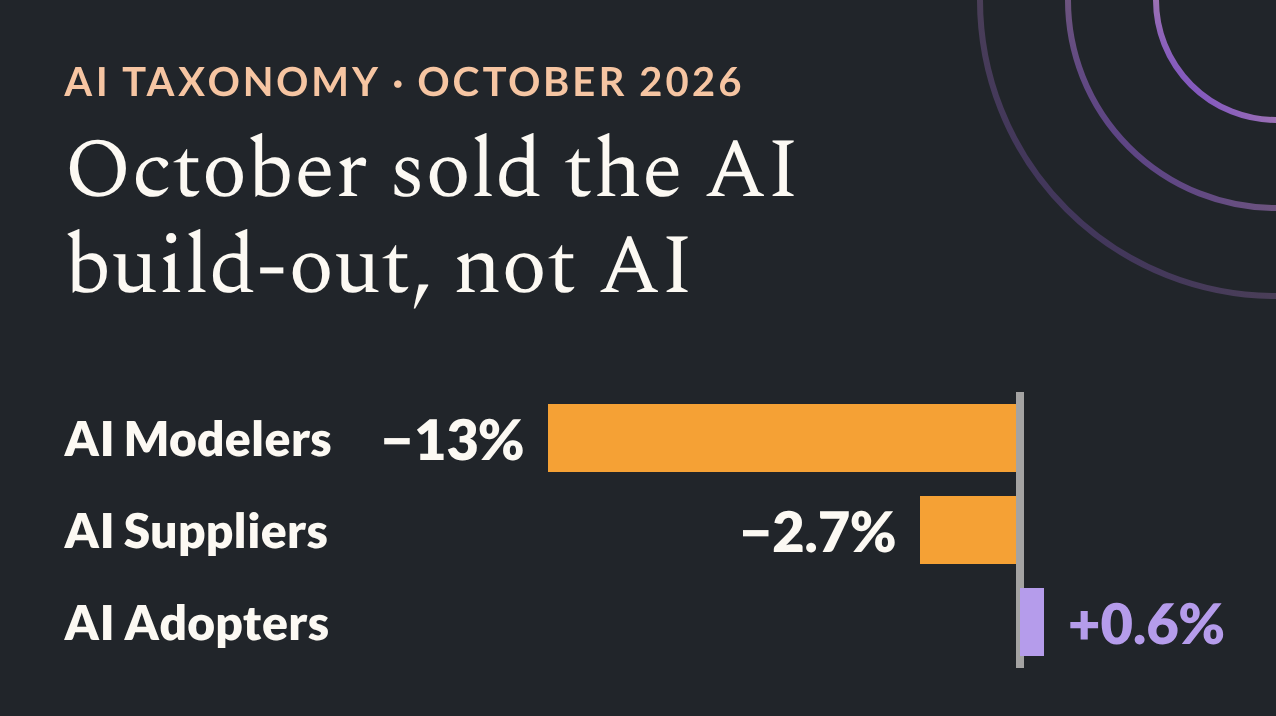
Omega Point’s AI Taxonomy shows AI Modelers fell 13% and Suppliers 2.7% in October while Adopters rose 0.6%. See which AI exposures drove returns.

Explore the networking and optical technologies linking AI chips and data centers, and the global companies positioned to benefit from rising bandwidth demand.